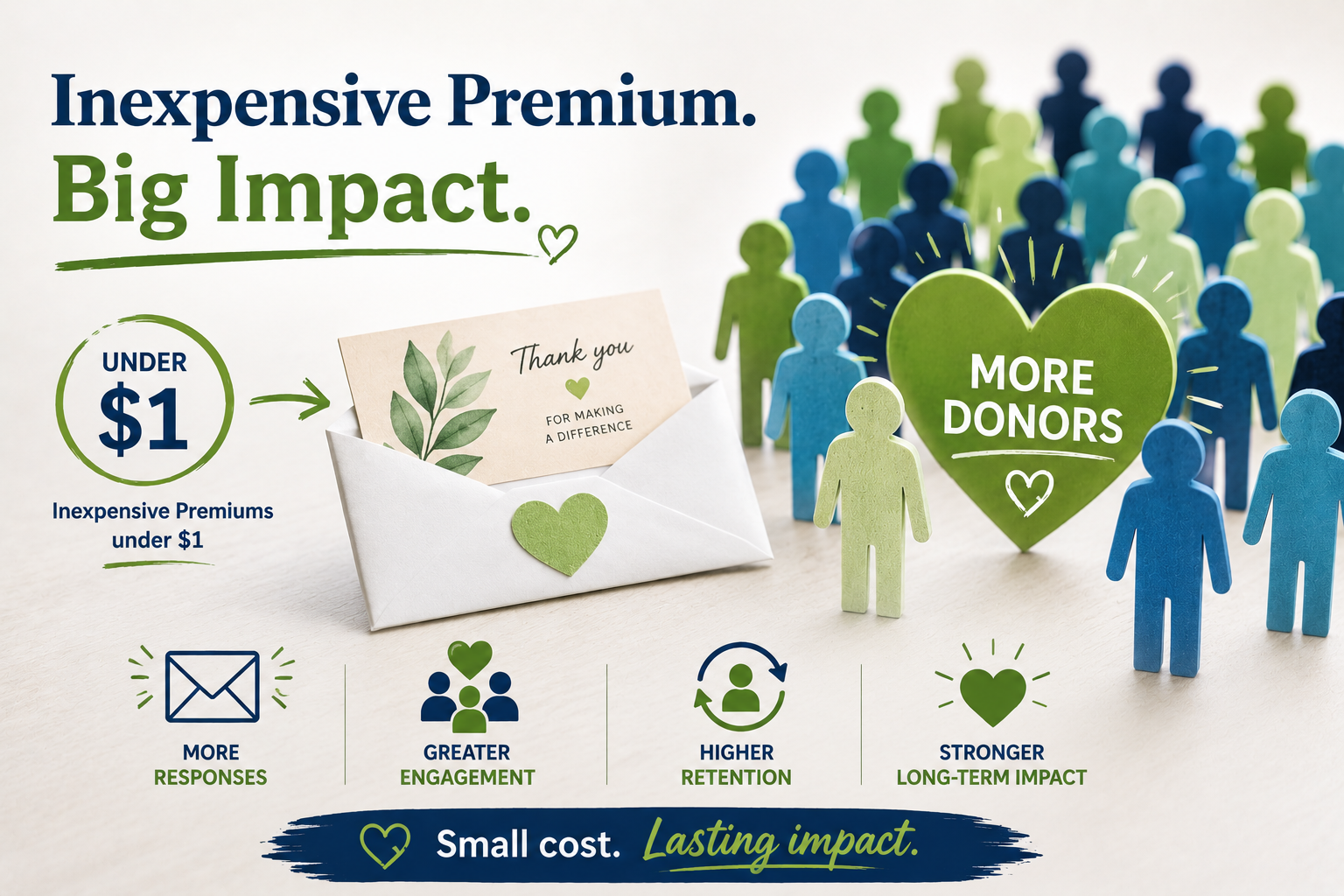
In today’s competitive fundraising landscape, nonprofits are under constant pressure to increase donor acquisition, improve retention, and generate stronger campaign ROI — without overspending.
While digital strategies and high-end cultivation gifts can play an important role, one of the most reliable ways to lift donor response is surprisingly simple:
A meaningful, highly mailable premium that costs $1.00 or less.
Low-cost premiums do not work because of their monetary value. They work because they tap into powerful donor motivations: identity, emotion, mission connection, and reciprocity.
When used strategically, these small physical touchpoints can turn a standard direct mail appeal into a more personal, memorable, and effective donor experience.
Why Low-Cost Premiums Work in Direct Mail Fundraising
Direct mail premiums succeed because they create an immediate connection with the donor before the letter is even read.
A coaster, chaplet, coin, pendant, bookmark, seed paper piece, or other mission-aligned item can make the donor feel recognized, included, and emotionally connected to the cause.
That emotional connection can be translated directly into stronger fundraising results.
Recent campaign performance shows just how effective these small premiums can be:
• CoasterAppeal achieved a 5.65% response rate, which is a strong result for an appeal program.
• The campaign also delivered a $50 average gift, outperforming the NPO’stypical average gift range of $45–$48.
• This is especially impressive because average gift size can sometimes decline in front-end premium packages — but that was not the case here.
• A Chaplet premium campaign, delivered in January, is currently showing a 15.6% response rate, demonstrating the powerful impact of a deeply mission-aligned premium.
These results reinforce a clear fundraising truth: when the premium is relevant, personal, and emotionally resonant, it can significantly increase donor engagement.
The Behavioral Science Behind Premium Fundraising
1. Reciprocity Encourages Donor Response
Behavioral economics shows that when someone receives an unexpected, unconditional gift, they often feel a natural desire to give back.
In direct mail fundraising, a front-endpremium costing between $0.20/each and $1.25/each can shift the recipient from a passive donor into an active participant in the relationship.
The gift does not need to be expensive. It needs to feel thoughtful, useful, and connected to the mission.
That is where low-cost premiums excel.
2. Premiums Create an Instant Emotional Connection
A well-chosen premium can create an emotional spark the moment the donor opens the envelope.
This is especially effective for:
• First-time donor prospects, because it reduces acquisition friction
• Lapsed donors, because it can reignite affinity with the organization
• Faith-based, advocacy, and identity-driven audiences, because the item can serve as a visible reminder of shared values
For example, a ring rosary for a faith-based audience is not just a small item. It is a meaningful symbol of belief, belonging, and mission alignment. That is why premiums like the ring rosary can generate such strong response rates.
3. Mission-Aligned Premiums Strengthen Donor Identity
The best premiums do more than attract attention. They reflect the donor’s values.
When a premium feels like a natural extension of the organization’s mission, it can become part of the donor’s daily life. That repeated visibility can help strengthen long-term commitment.
Mission-aligned premiums can support:
• Higher first-year donor retention
• Faster progression to a second gift
• Increased donor lifetime value
• Stronger emotional connection to the cause
A donor who keeps a premium is also keeping a reminder of your organization close by.
Why Under $1.00 Is the Direct Mail Sweet Spot
For many nonprofit direct mail campaigns, $1.00or less is the ideal premium cost range.
It is low enough to support large-scale acquisition campaigns, appeals, and testing. At the same time, it is high enough to allow for quality materials, custom designs, die cuts, and meaningful presentation.
This price point creates the right balance between:
• Production efficiency
• Donor impact
• Perceived value
• Campaign scalability
• Fundraising ROI
A premium does not have to be costly to be effective. It simply has to feel intentional.
How Front-end Premiums Can Improve Campaign Performance
Across direct mail fundraising benchmarks, low-cost, high-perceived-value premiums have been shown to generate strong results, including:
• Response rate lifts: 50% to 150%
• Average gift increases: 20% to 40%
• Immediate campaign ROI: 150% to 250%
• Year-over-year retention lifts: 15% to 30%
The December Coaster Appeal and PPFA chaplet results demonstrate how this can play out in real campaigns.
What Makes a High-Performing Premium?
Not every premium will drive results. To perform well, the item must be strategically developed for both donor psychology and direct mail production.
A successful low-cost premium should meet four key criteria.
1. Strong Mission Alignment
The premium should feel like a natural extension of the cause.
Examples include:
• Native seed paper for conservation organizations
• Custom medals for faith-based ministries
• Custom metal products, such as charms or jewelry, for community foundations
• Coasters, prayer cards, ornaments, magnets, bookmarks, or lapel pins tied to a campaign message
The donor should immediately understand whythe item was included and how it connects to the organization’s work.
2. Pride, Meaning, and Utility
A premium works best when the donor wants to keep it.
If the donor thinks, “This represents who I am,” the item is far more likely to stay in their home, car, office, wallet, or prayer space.
That lasting presence matters.
Durable materials, attractive design, and emotional relevance all increase the perceived value of the premium — even when the actual production cost remains low.
3. USPS-Friendly Design
For direct mail fundraising, mailability matters.
The best front-end premiums are:
• Flat
• Flexible
• Lightweight
• Under0.25 inches thick
• Designed to fit efficiently into standard envelope packages
This helps nonprofits avoid unnecessary postage increases and keeps the campaign scalable.
Another important production advantage is that front-end premiums can be packed on cards and inserted into tight poly bags for easy lettershop machine insertion. This helps streamline production and can reduce lettershop handling costs for the nonprofit.
In other words, a well-designed premium does not just improve donor response. It can also support operational efficiency.
4. Smart Copywriting and Donor Framing
The premium may get the envelope opened, but the letter still must complete the donor journey.
Strong copy should explain
• Why the donor is receiving the item
• How the premium connects to the mission
• Why their support is urgently needed
• What their gift will accomplish
• How they are part of the solution
The item is the spark. The story, offer, and call to action are what convert interest into response.
Premiums Are Not Add-Ons. They Are ROI Tools.
A low-cost premium should not be treated as a decorative extra. It is a strategic fundraising tool rooted in donor psychology.
When thoughtfully designed, a small premium can:
• Increase open rates
• Improve response rates
• Protector lift average gift
• Reactivate lapsed donors
• Strengthen donor identity
• Improve retention
• Boost overall direct mail ROI
In a digital-first world, donors still respond to tangible, authentic connection. A small, mission-aligned gift can be the difference between an ignored envelope and an opened letter — between a passive reader and an engaged donor.
Ready to Boost Your Next Direct Mail Campaign?
If you are looking for a cost-effective way to improve donor response and campaign ROI, a low-cost premium may be the right strategy for your next appeal or acquisition mailing.
Schedule a call with our team today to learn how custom premiums could help boost ROI in your next direct mail campaign.